
Event Mapping
Learn how AnyTrack Event Mapping works to route conversion events from your integrations to ad platforms like Google Ads, Facebook Ads, and TikTok Ads. Control which events each platform receives, map to standard or custom events, and optimize campaign performance across channels.
Event Mapping controls which conversion events AnyTrack sends to each connected ad platform. Map events from your integrations to AnyTrack standard or custom events, then define how those events are sent to Google Ads, Facebook Ads, TikTok Ads, and other platforms.
How Event Mapping works
Section titled “How Event Mapping works”Event Mapping follows a two-step chain:
-
Integration to AnyTrack: Events from your connected integrations (eCommerce platforms, CRMs, affiliate networks, webhooks) are mapped to AnyTrack events. These can be standard events like
PurchaseorLead, or custom events likeDealWon. -
AnyTrack to ad platforms: Each AnyTrack event is then mapped to the corresponding event on each connected ad platform. Standard events auto-map to each platform’s equivalent (for example, AnyTrack
Purchasemaps to FacebookPurchaseand Googlepurchase). Custom events appear in the ad platform mapping section and require manual mapping.
Once an event is mapped, it appears in your AnyTrack dashboard and reports, and becomes available in the ad platform event mapping section for each connected platform.
Event sources
Section titled “Event sources”AnyTrack tracks events from two sources:
Tracking Tag: The AnyTrack Tracking Tag collects client-side events on your website: page views, outbound clicks, form submissions, and cart interactions.
Postback, Webhook, or API: Your connected integrations (affiliate networks, eCommerce platforms, CRMs) send server-side events to AnyTrack via postbacks, webhooks, or direct API calls. These include leads, purchases, registrations, and pipeline events.
AnyTrack standard events
Section titled “AnyTrack standard events”Each standard event has an automatic mapping to every connected ad platform. When a standard event is triggered, AnyTrack translates it to the correct format for each platform.
| Event Name | Description | Source |
|---|---|---|
| OutboundClick | User clicks an external link | Tracking Tag |
| ViewContent | User views a product or content page | Tracking Tag |
| AddToCart | User adds an item to the cart | Tracking Tag, Postback/Webhook |
| InitiateCheckout | User starts a checkout process | Tracking Tag, Postback/Webhook |
| FormSubmit | User submits a form | Tracking Tag |
| Schedule | User books an appointment or meeting | Postback, Webhook, or API |
| Lead | A new lead is created | Postback, Webhook, or API |
| CompleteRegistration | A qualified lead with additional engagement | Postback, Webhook, or API |
| Purchase | A completed purchase with monetary value | Postback, Webhook, or API |
| Upsell | A customer purchases an additional product or upgrade | Postback, Webhook, or API |
Customizing your Event Mapping
Section titled “Customizing your Event Mapping”Each ad platform integration in AnyTrack has its own Event Mapping configuration. You can:
- Disable events you do not want to send to a specific ad platform.
- Change the mapping to a different standard event on the ad platform (for example, map AnyTrack
Leadto FacebookCompleteRegistrationinstead ofLead). - Map to custom event names: when you enter a custom name, AnyTrack sends that event to the platform as a custom conversion.
- Map custom AnyTrack events to standard or custom events on the ad platform.
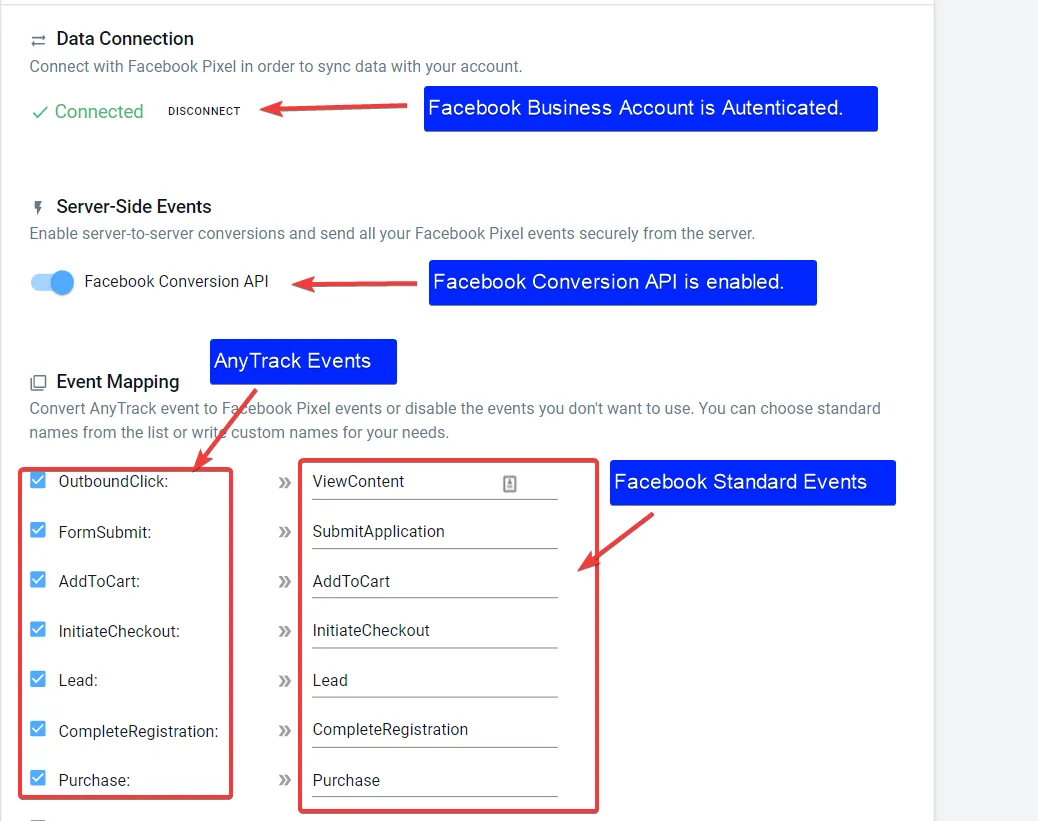
The illustration above shows AnyTrack standard events on the left mapped to Facebook standard events on the right. This same mapping interface is available for every connected ad platform.
Cross-platform use case
Section titled “Cross-platform use case”Event Mapping enables cross-platform campaign optimization. For example, you could:
- Run a top-of-funnel campaign on one platform, tracking engagement events like
OutboundClickandViewContent - Retarget users who triggered those events on a second platform with a purchase-focused campaign
- Build lookalike audiences on each platform based on users who triggered
Purchase - Exclude purchasers from acquisition campaigns across all platforms
Because Event Mapping standardizes your events across platforms, you set it up once and all connected ad platforms receive consistent, optimized conversion signals.
Event Mapping FAQ
FAQ was last reviewed on 2026-10-14
What happens when I map an integration event to a custom AnyTrack event?
Can I map the same AnyTrack event differently on each ad platform?
Do I need to configure Event Mapping for every ad platform I connect?
What is the difference between client-side and server-side events?
Can I send custom events to ad platforms?
Can I split one <code>Purchase</code> event into a separate conversion action per product?
Purchase event send the product details as payload — Digistore24, for example, includes product_id and product_name — but that payload does not create separate events, so it cannot drive the mapping. A custom event row in the ad platform mapping section only fires when an AnyTrack custom event of that name is generated, and building the row does not create the event. To send products to separate conversion actions, each product must produce its own AnyTrack event before you map it.