
LeadByte Integration
Connect LeadByte to AnyTrack with a webhook. AnyTrack attributes each LeadByte lead, validation, and sale to the ad campaign that sent the visitor.
What the LeadByte Integration Does
Section titled “What the LeadByte Integration Does”LeadByte is a lead distribution platform: it receives leads, validates them, and sells them to lead buyers. The LeadByte integration sends each of these steps to AnyTrack through a webhook. AnyTrack attributes each event to the ad click and traffic source of the visitor’s session on your website.
On the Starter plan and higher, AnyTrack also sends these conversions to your ad platforms through the Conversion API. On the Free plan, AnyTrack tracks the conversions and shows them in your reports. It does not send them to ad platforms.
Technical details
Section titled “Technical details”| Supported features | LeadByte |
|---|---|
| Tracking method Via Webhook | Server-side tracking |
| Setup method | Webhook URL |
| |
| Event attributes | |
| Conversion Mapping Rename or turn off events. | Yes |
| Combined Orders Groups upsells with the purchase. | No |
| Tracking Group Integration reference for AutoTag. | leadbyte |
| Tracking parameter Carries the click_id. | c3 |
How the Integration Works
Section titled “How the Integration Works”- Session: A visitor lands on your website. The AnyTrack Tag records the traffic source and the UTM parameters. It also generates the Click ID of the session.
- Form submission: The visitor submits your lead form. The AnyTrack Tag puts the Click ID into a hidden field with the default value
--CLICK-ID--. - Lead delivery: Your form sends the lead to LeadByte. The Click ID goes into the LeadByte
c3field. - Webhook: LeadByte sends a webhook to AnyTrack when it validates the lead, offers the lead to buyers, and sells the lead.
- Attribution: AnyTrack reads the Click ID in the
c3field and attributes the conversion to the original session.
Conversion Events
Section titled “Conversion Events”AnyTrack converts each LeadByte webhook into one of these Standard Events:
| Event | When LeadByte sends it | Data source |
|---|---|---|
Lead | LeadByte receives a valid lead. | Webhook |
CompleteRegistration | LeadByte offers the valid lead to lead buyers. | Webhook |
Purchase | LeadByte sells the lead to a buyer. | Webhook |
The value of the Purchase event is the total revenue from all buyers of the lead. The currency is the currency of the LeadByte campaign. If LeadByte does not sell the lead, AnyTrack does not create a Purchase event.
Set Up the LeadByte Integration
Section titled “Set Up the LeadByte Integration”Step 1: Add LeadByte to Your AnyTrack Property
Section titled “Step 1: Add LeadByte to Your AnyTrack Property”- Open the Integration Catalog in AnyTrack.
- Search for LeadByte.
- Click the LeadByte card.
- Click Install.
- Copy the webhook URL that AnyTrack shows.
Step 2: Add the AnyTrack Webhooks in LeadByte
Section titled “Step 2: Add the AnyTrack Webhooks in LeadByte”AnyTrack needs two LeadByte webhooks: one for valid leads, and one for sold leads.
- In LeadByte, open Tech Hub > Outbound Webhooks.
- Create a webhook with the type Lead Valid/Invalid.
- Enter a reference, for example
AnyTrack (Leads). - Paste the AnyTrack webhook URL.
- Keep the standard payload. Do not set the payload type to Custom. A custom payload can change the format of the Click ID.
- Save the webhook.
- Create a second webhook with the type Lead Sold/Unsold.
- Enter a reference, for example
AnyTrack (Sales). - Paste the same AnyTrack webhook URL.
- Keep the standard payload.
- Save the webhook.
- Verify that neither webhook is in the Inactive tab. LeadByte does not trigger inactive webhooks.
To send sample data before you go live, click Test at the bottom of each webhook. LeadByte keeps a log of each webhook request in its webhook logs.
The webhook URL has this format. Use the URL from your AnyTrack account, not this example:
https://t1.anytrack.io/xxxxxxx/collect/leadbyteStep 3: Pass the Click ID to the c3 Field
Section titled “Step 3: Pass the Click ID to the c3 Field”- Add a hidden field to your lead form.
- Set the default value of the hidden field to
--CLICK-ID--. The AnyTrack Tag replaces the token with the Click ID of the session. - Map the hidden field to the LeadByte
c3field.
If your form provider does not support hidden fields, see Where the Click ID Comes From.
Step 4: Adjust the Event Mapping
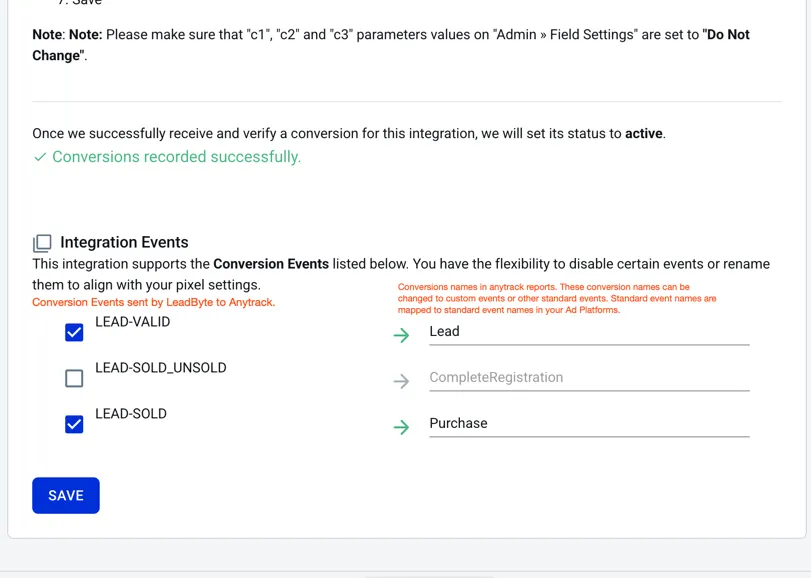
Section titled “Step 4: Adjust the Event Mapping”The Event Mapping sets which events AnyTrack sends to your ad platforms, and under which names. Open the LeadByte integration settings to change the default mapping.
Verify Your Integration
Section titled “Verify Your Integration”- The AnyTrack Tag loads on the page that holds your lead form.
- Your form has a hidden field with the default value
--CLICK-ID--, mapped toc3. - LeadByte has two active webhooks to AnyTrack: Lead Valid/Invalid and Lead Sold/Unsold.
- Every LeadByte delivery has a buyer.
- The
c3field of the LeadByte campaign has no Format and no Mask. - The Click ID in LeadByte has the same letters and case as the Click ID in AnyTrack.
- A test lead in LeadByte shows a Click ID in
c3(for examplexZDGbrPkXHcuKgRM5NHep8dv7exre7T3a5), not the literal--CLICK-ID--token. - The test events show as valid in the Events Log of the LeadByte integration.
Webhook Payload Example
Section titled “Webhook Payload Example”LeadByte sends a payload like this example. The c3 field inside record.lead holds the AnyTrack Click ID.
{ "count": 1, "index": 0, "callbackType": "LEAD-SOLD_UNSOLD", "record": { "campaign": { "name": "Campaign name", "reference": "1", "currency": "USD", "id": 1, "deliveryModel": "Hybrid" }, "buyers": [ { "name": "Lead buyer name", "reference": "12", "revenue": 260, "id": 31, "status": "Sold" } ], "lead": { "contactemail": true, "firstname": "John Doe", "county": "California", "source": "google", "ssid": null, "phone1": "7024888888", "sid": "1", "street1": null, "id": 4400320, "street2": null, "contactphone": true, "email": "johndoe@gmail.com", "optinurl": null, "received": "2023-05-29T07:10:09Z", "c1": null, "c2": null, "c3": "XXXXXXPkXHcuKgRM5NHep8dv7exre7T3a5" }, "callbackReference": "AnyTrack (Purchases)", "deliveries": [ { "reference": "any reference", "scheduleTime": "2023-05-29T07:10:10Z", "validResponse": true, "delay": 0, "rawResponse": "Lead Assigned", "requestUrl": null, "id": 51, "sentAt": "2023-05-29T07:10:10Z", "status": "Sent", "responseLabel": "Success" } ], "supplier": { "name": "The lead Supplier", "commission": 0, "id": 1, "payoutType": "Buyer Delivery Accept", "sid": "1", "status": "Buyer Rejection" } }}Where the Click ID Comes From
Section titled “Where the Click ID Comes From”AnyTrack merges two data sets. The first is the session on your website: UTM parameters, traffic source, and first-party data. The second is the offline events that LeadByte reports through its webhook. The merge uses the AnyTrack Click ID, which the AnyTrack Tag generates for each session. LeadByte receives the Click ID through the c3 field, so your form must pass the value to LeadByte.
LeadByte often receives leads from an upstream form or decision tree (for example LeadsHook). Pass the AnyTrack Click ID into the LeadByte c3 field when the upstream tool delivers the lead.
Each source platform exposes the Click ID under its own parameter. Pass that value into c3:
| Source platform | Click ID parameter | Destination in LeadByte |
|---|---|---|
| Typeform | at_click_id | c3 |
| Unbounce | click_id | c3 |
| Elementor | click_id | c3 |
| Calendly | utm_term or sfid | c3 |
| LeadsHook | atclid | c3 |
| Any standard HTML form | hidden field, value --CLICK-ID-- | c3 |
For the full pattern across every platform, see Pass the Click ID from External Forms to Your CRM.
Related Resources
Section titled “Related Resources”- Install the AnyTrack Tag
- AnyTrack Click ID
- Pass the Click ID from External Forms to Your CRM
- Events Log
- Track Forms and Pass Click IDs
Frequently Asked Questions
FAQ was last reviewed on 2026-10-19
How do I track LeadByte conversions in AnyTrack?
c3 field. AnyTrack then attributes each LeadByte event to the ad click that started the session.Why is the c3 field empty in LeadByte?
--CLICK-ID--, mapped to c3. Verify that the AnyTrack Tag loads on the page that holds the form. If you use LeadsHook, Unbounce, Elementor, or Typeform, follow the guide for that platform.Why does AnyTrack not track a LeadByte lead that has a Click ID in c3?
c3 field of the campaign. If your webhook uses a Custom payload, remove any format or encryption option on the c3 tag.Can I use a LeadByte field other than c3 for the Click ID?
c3. AnyTrack also reads the Click ID from c2 and c1 when c3 does not contain a valid Click ID.