
AnyTrack Click ID
Learn how the AnyTrack Click ID uniquely identifies visitors across your marketing stack, connecting ad clicks to conversions for cross-platform attribution.
The Click ID is the thread that connects every touchpoint in your customer journey. The Tracking Tag generates this unique identifier when a visitor lands on your site. The Click ID then follows the visitor through page views, form submissions, external affiliate offers, and purchases, so AnyTrack can attribute conversions to the ads that drove them when the Click ID is preserved through the flow.
Without Click IDs, conversions tracked on third-party platforms (affiliate networks, external checkouts, CRM webhooks) would be orphaned data points with no way to connect back to marketing spend. With Click IDs, conversions can tie back to campaign performance when the Click ID is passed through each step of the flow.
What Is the AnyTrack Click ID?
Section titled “What Is the AnyTrack Click ID?”The AnyTrack Click ID is a unique, anonymous and auto-generated alphanumeric string that enables AnyTrack to tie your visitor’s actions across your marketing flows and marketing tech stack.
Example Click ID
Section titled “Example Click ID”IBTO9lOfAMybrKiiB1U9YG91IFjs3Dv9AV
Automatic vs. Manual Implementation
Section titled “Automatic vs. Manual Implementation”For most users: AnyTrack generates and manages the Click ID automatically when you connect standard integrations from the Integration Catalog. No manual setup is required.
For custom setups: The Click ID value is still generated automatically by the Tracking Tag. “Manual” only means that you collect or pass the value yourself, and the right method depends on the context:
- Add the
--CLICK-ID--token (no code) — Place the token on the element you want to track: an affiliate link, a product link, or a hidden form field. The Tracking Tag substitutes the token with the Click ID value automatically. See Form Tracking for forms and AutoTag for links. - Append the Click ID to the page URL — Use the
atclidToUrlcommand when the Tracking Tag cannot reach the element, for example embeds, iframes, or form builders that collect values from URL parameters. - Retrieve the value with JavaScript (last resort) — Use
AnyTrack('atclid')only when you need the raw value itself, for example to sync it into a CRM field or a Google Tag Manager variable. See the Manual Implementation Guide below.
How Click IDs Work
Section titled “How Click IDs Work”Generation Process
Section titled “Generation Process”The Click ID is automatically generated by the AnyTrack Tracking Tag for every standard and custom event triggered on your website. For example, when a user adds a product to their cart, AnyTrack generates a Click ID.
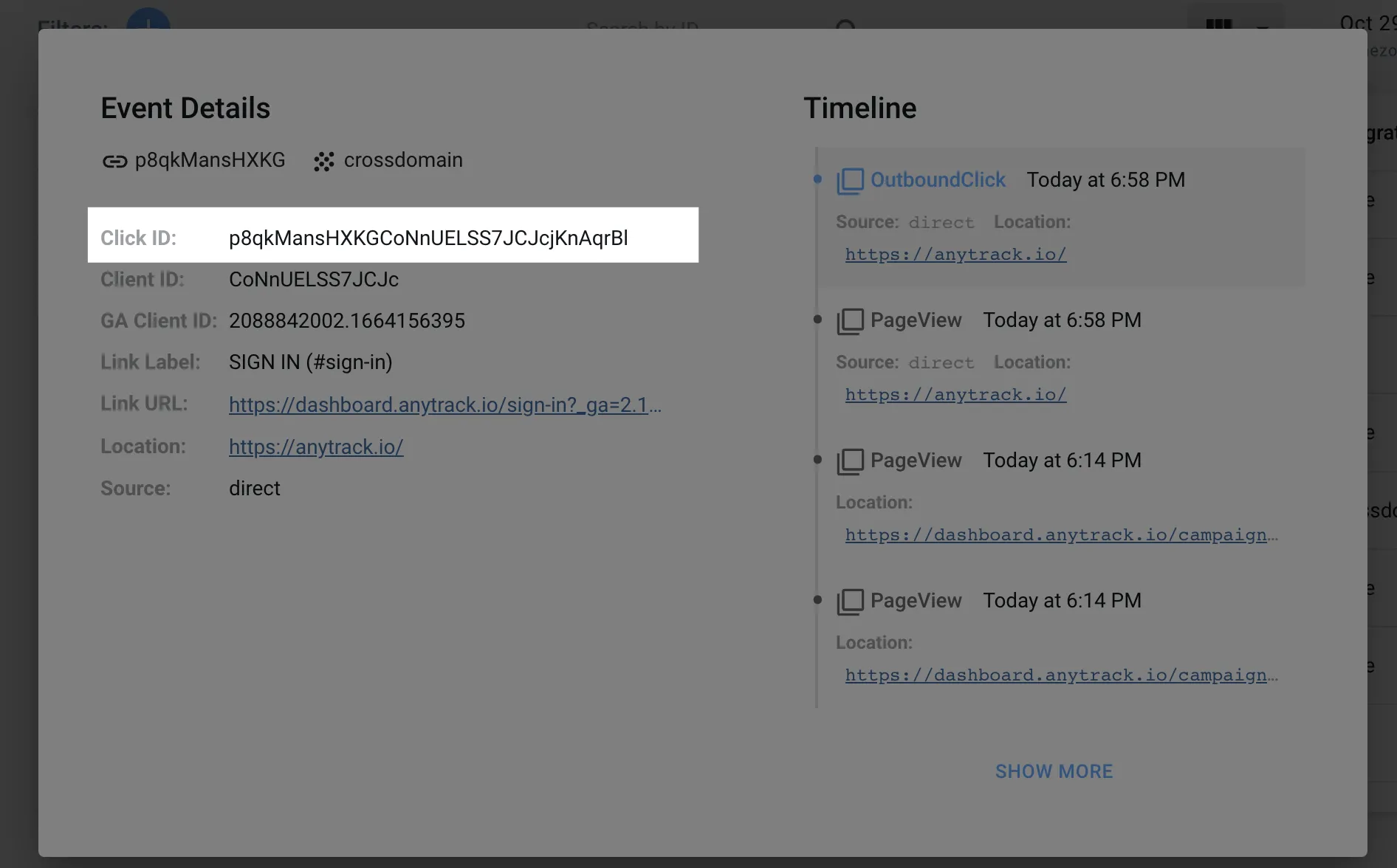
Anatomy of the Click ID
Section titled “Anatomy of the Click ID”The AnyTrack Click ID is composed of 3 strings that allow AnyTrack to construct the user journey and timeline:
| Property ID (12 characters) | Client ID (14 characters) | Unique Key (8 characters) |
|---|---|---|
IBTO9lOfAMyb | rKiiB1U9YG91IF | js3Dv9AV |
For the full identifier reference, including the difference between the 30-character page-level atclid and the 34-character element-level click_id, see AnyTrack Identifiers.
Attribution Flow
Section titled “Attribution Flow”The AnyTrack Click ID works by following the user’s journey from the moment they click on your ad or affiliate link, through their engagement on your website, and ultimately to their conversion.
This process is achieved through a series of steps:
- Generation: When the visitor lands on your site from an ad or affiliate link, the Tracking Tag generates a unique Click ID
- Attribution: The Click ID is attached to the user’s browser session, allowing the platform to attribute all subsequent interactions to that specific user
- Tracking: The AnyTrack platform tracks the user’s actions throughout their journey, from ad click to conversion, using the Click ID
- Reporting: AnyTrack aggregates the collected data into reports that you can use to optimize your campaigns
How the Click ID is Used
Section titled “How the Click ID is Used”The Click ID is used to stitch client-side and server-side events. For example, the Click ID appended to the Shopify Cart is triggered via the client-side interaction and is recorded in the Shopify servers.
When the customer completes their journey with a Purchase, the Click ID is sent to AnyTrack via the Webhook Notifications triggered in the Shopify Servers.
You can see the Click ID value in the Shopify integration’s Events Log:
Why Click IDs Matter for Marketers
Section titled “Why Click IDs Matter for Marketers”The AnyTrack Click ID (whether automatic or manual) enables you to:
- Attribute conversions — Attribute tracked conversions to the campaign, ad placement, or affiliate network that drove them when the Click ID is preserved through the flow
- Optimize marketing efforts — Make better-informed decisions for optimizing campaigns, ad placements, and affiliate partnerships with accurate attribution data
- Increase ROI — Identify high-performing marketing channels and strategies to allocate budget more effectively
- Enhance user experience — Identify user behavior patterns and preferences to refine website content and user experience
Manual Implementation Guide (Advanced Users Only)
Section titled “Manual Implementation Guide (Advanced Users Only)”Retrieve the atclid Value with JavaScript
Section titled “Retrieve the atclid Value with JavaScript”The atclid variable is a Click ID generated from the current user session without relating it to any particular event. The Tracking Tag generates the value automatically; the command only retrieves it. Use the following code to retrieve it:
var atclid = AnyTrack('atclid');Important: This code will work only AFTER the Tracking Tag is loaded on your page. To verify the code is already loaded, you can use this script:
AnyTrack(function() { var atclid = AnyTrack('atclid'); // do something with atclid...});Google Tag Manager Implementation
Section titled “Google Tag Manager Implementation”- Create a new JavaScript Variable
- Insert the following Code and Save
- Now you can use the
atclidvalue in any of the tags within your Google Tag Manager container
function() { return AnyTrack('atclid');}Advanced Use Cases
Section titled “Advanced Use Cases”Custom Integrations and Advanced Tracking Methods
Section titled “Custom Integrations and Advanced Tracking Methods”When your marketing flow requires more than a standard integration available in the AnyTrack catalog, the Click ID is the key that enables the persistence of a session between the platforms or apps you are using.
As long as the Click ID passes between the platforms in your flow, AnyTrack can track the conversions and send them to your analytics platforms and to your ad platforms via the Conversion API (available on Starter and above).
For a hop-by-hop walkthrough of how the Click ID travels through an affiliate network and comes back in the postback, see the Affiliate Click ID Journey.
Marketing Automation Platforms
Section titled “Marketing Automation Platforms”Let’s say that you are running ads on Facebook and collecting opt-ins via a Typeform embed on your Elementor/WordPress website:
- Collect the Click ID via Elementor
- Sync the Click ID with ActiveCampaign subscribers
- Trigger Offline Sales: Whenever your sales team updates the subscribers status or deal stage, you can trigger a webhook or a Zapier automation that will send the conversion event to AnyTrack
👉 Learn how to use webhooks and Zapier.
Email Marketing Campaigns and Cross-Device Tracking
Section titled “Email Marketing Campaigns and Cross-Device Tracking”When you send emails to your subscribers, append the click ID to your campaign URLs. AnyTrack then identifies the customer and stitches the new session with the initial subscriber session.
This maintains cross-device tracking and attribution when users switch between devices.
Best Practices
Section titled “Best Practices”- Use standard integrations first — Check the AnyTrack catalog for available integrations before implementing custom solutions
- Prefer the token over code — Use the
--CLICK-ID--token or theatclidToUrlcommand before you write custom JavaScript - Always verify that the Tracking Tag is loaded before trying to retrieve the
atclid(for custom implementations) - Maintain consistency in how you pass Click IDs between different platforms and systems
- Test your implementation regularly to ensure Click IDs are being generated and passed correctly
- Document your custom integrations for future reference and troubleshooting
Related Articles
Section titled “Related Articles”Frequently Asked Questions
FAQ was last reviewed on 2026-10-11