
Troubleshooting Facebook Ads
Troubleshoot your Facebook Ads integration with AnyTrack. Learn which Meta deduplication warnings you can safely ignore, how to reconnect a disconnected Meta Pixel, fix overreporting of attributed results, and resolve campaigns that do not appear in the Campaign Report.
Meta Pixels send warning notifications. While some are false positives, many indicate setup issues requiring attention.
See Ad Platforms Attribution for the timing details on Meta Events Manager and Ads Manager delays.
Deduplication Warnings You Can Ignore
Section titled “Deduplication Warnings You Can Ignore”Meta deduplication warnings apply when the same event reaches Facebook from both the browser pixel and the server. AnyTrack sends conversions to Facebook exclusively server-side through the Conversion API, so no duplication occurs within your account and no deduplication key is needed. You can safely ignore the warning variants below unless other systems also send data to your Meta Pixel.
- Event missing deduplication parameters
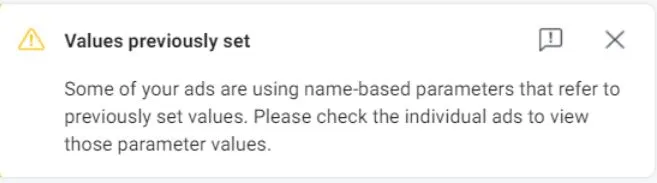
- Values previously set
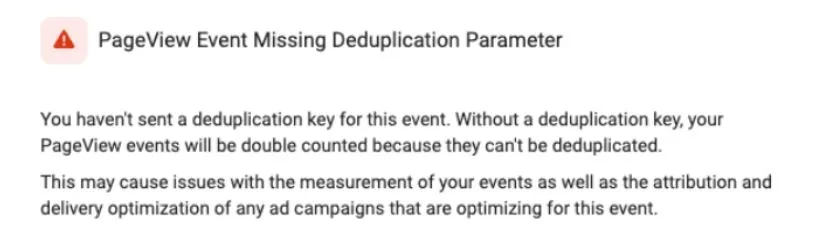
- PageView event missing deduplication parameter
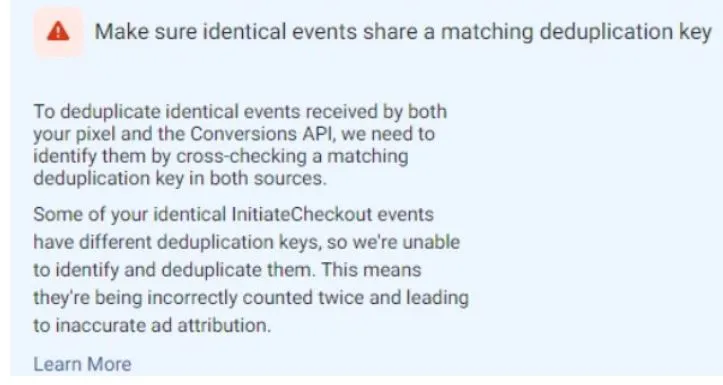
- Make sure identical events share a matching deduplication key
Values Previously Set
Section titled “Values Previously Set”Ignore this warning. It appears when you update your UTM Tracking Template.
PageView Event Missing Deduplication Parameter
Section titled “PageView Event Missing Deduplication Parameter”The PageView event is fired by the base Tracking Tag and is not sent via the Conversion API. It doesn’t need a deduplication key.
Matching Deduplication Keys for Identical Events
Section titled “Matching Deduplication Keys for Identical Events”Disregard these warnings unless other systems send data to Facebook.
Disconnected Meta Pixel
Section titled “Disconnected Meta Pixel”AnyTrack sends an email notification if your Meta Pixel disconnects. This stops AnyTrack from sending conversion data to Facebook.
Common causes:
- Password change (invalidates token)
- Manual token revocation in Facebook Business Manager
- API permission changes
- API updates
- Token expiration
How to fix:
- Go to Tracking Pixels in your AnyTrack dashboard
- Look for a yellow warning indicator on your Facebook Pixel
- Click Reconnect and authorize the connection
- Verify that the Conversion API slider is enabled
Overreporting Attributed Results
Section titled “Overreporting Attributed Results”If the Campaign Report shows significantly more Attributed Results than Purchase or Lead events, another system is likely sending events. It could be another tracking software or Meta Pixel code installed directly or through an integration.
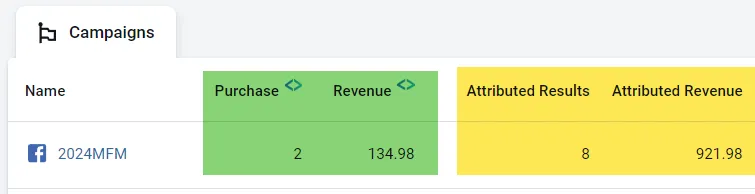
When you install the AnyTrack Tracking Tag and connect your Facebook Ads account, AnyTrack automatically loads the Meta Pixel. Remove any Meta Pixel installed directly on your website to prevent duplicates.
To quickly identify if conversion events are reported by systems other than AnyTrack, navigate to Meta Events Manager and ensure that Integration is not Multiple.
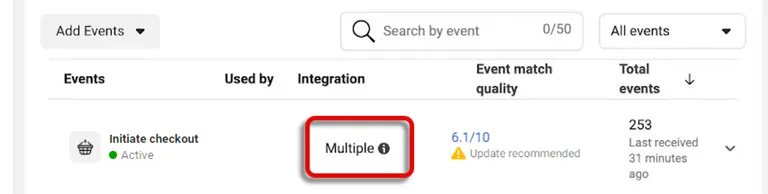
How to fix:
- Check Meta Events Manager for “Multiple” integration status
- Remove any other Meta Pixel installations from your website
- Disable other tracking plugins or integrations sending to Facebook
- Follow this guide to identify systems sending events to Facebook
Identify Which System Sent an Event
Section titled “Identify Which System Sent an Event”Meta Events Manager names the sender of every event in the Source column. Read that column before you change any tracking code.
AnyTrack sends conversions to Meta exclusively server-side through the Conversion API. The Tracking Tag loads the Meta Pixel and triggers PageView in the browser. AnyTrack sends no other browser event.
| Source value | Which system sent the event |
|---|---|
Conversions API | The server sent the event. AnyTrack sends every conversion this way. |
Meta Pixel | The browser sent the event. AnyTrack does not send conversions from the browser. |
Multiple | More than one system reports the event. |
A conversion row that shows Meta Pixel or Multiple comes from a second system. Find that system before you act:
- Open Meta Events Manager and select the dataset connected in AnyTrack.
- Open the Overview tab and read the Source column for each event.
- Note every event whose Source is not
Conversions API. - Remove the system that sends those events. Your funnel platform, your shop platform, a Google Tag Manager tag, or a plugin can each send them.
Funnel Platforms That Send Their Own Purchase Event
Section titled “Funnel Platforms That Send Their Own Purchase Event”Some funnel platforms carry a Meta Pixel field and send their own purchase event from the browser. The event uses the platform’s name, not the AnyTrack event name. GoHighLevel sends OrderFormPurchase from the order form.
The platform sends the event without a value and without a currency. Meta then reports two warnings on the event. One warning reads “Prices in value parameter are the same for all web events”. The other reads “No event parameters were detected”.
Remove the Meta Pixel from the platform:
- Open the funnel settings and remove the Meta Pixel ID.
- Open the order form or checkout settings and remove the Meta Pixel ID.
- Open the platform’s integrations screen and disconnect the Facebook connection.
- Remove Meta Pixel tracking from the platform’s forms and workflows.
- Republish the funnel.
- Run a test purchase. Confirm that
Purchasearrives with the SourceConversions API, a value, and a currency.
For GoHighLevel, see Meta Shows a GoHighLevel OrderFormPurchase Event.
Price Data Actions in Meta Events Manager
Section titled “Price Data Actions in Meta Events Manager”Meta lists two data-quality actions when your dataset receives conversions without a correct value:
| Meta action | When Meta shows the action |
|---|---|
| Send valid price data for better performance optimization | The events send the same price. |
| Send higher quality price data for better performance optimization | The events send a malformed value, or no value. |
Meta ranks both actions as High priority. Meta states the number of affected ad sets and models a return on ad spend (ROAS) gain. Treat both actions as a second data source until the Source column proves otherwise.
AnyTrack sends the order value and the currency on every conversion. See Multi-Currency. If your dataset receives a purchase event without a value, AnyTrack did not send that event.
An Event You Did Not Configure Appears in Meta
Section titled “An Event You Did Not Configure Appears in Meta”Your Meta Pixel shows an event you never set up. One common example is SubscribedButtonClick on a cart or checkout button.
AnyTrack sends conversions to Meta only through the Conversion API. AnyTrack uses only the event names in your Event Mapping. An event name you did not map therefore comes from a browser-side source on your site.
How to confirm the source:
- Open the event in Meta Events Manager.
- Read the Received from and Setup method columns. An event that shows
BrowserandAutomatically loggedcomes from Meta’s own automatic event detection, not from AnyTrack. - Open Tracking Pixels in AnyTrack and open your Facebook Pixel.
- Go to the Event Mapping section. Confirm that your mapping sends the action under the event name you expect.
How to remove the browser-side source:
- Meta automatic events — Open Meta Events Manager, go to Pixel Settings, and set Track Automatic Events to off. Meta detects some button clicks without any code on your site.
- The Shopify Facebook & Instagram sales channel — Disable data sharing between Shopify and Facebook. Keep the catalog settings enabled for catalog campaigns. See the Shopify Setup Checklist.
- Another app or a hardcoded snippet — Remove any other Meta Pixel installation. AnyTrack loads the Meta Pixel after you connect Facebook Ads, so a second installation is a duplicate.
Keep the Conversion API enabled in AnyTrack. Trigger the action again. Confirm that it reaches Meta as a server event under the mapped name.
Events Are in AnyTrack but Not in Meta Events Manager
Section titled “Events Are in AnyTrack but Not in Meta Events Manager”Your events appear in the Conversions Report, but Meta Events Manager shows nothing.
After the dataset matches, check these four causes in order:
- The Tracking Tag is not on your website. Open your AnyTrack dashboard and look at the sessions graph. Zero sessions means the Tracking Tag no longer loads, and Meta Events Manager then shows nothing at all: AnyTrack loads the Meta Pixel, so no tag also means no
PageViewand no_fbpcookie. A theme change, a theme update, or a developer edit removes a tag installed in your theme files. Your store keeps sending server-side events from webhook integrations such as Shopify, which is why events can still appear in AnyTrack while sessions stop. Reinstall the tag and confirm it with the AnyTrack Pixel Helper. See Install the AnyTrack Tag. - The tab you use. The Test Events tab shows AnyTrack’s server events only after you paste Meta’s test event code into AnyTrack. Until then, the tab can show
PageViewalone. This behavior is normal. For the full setup, see Meta CAPI Test Mode. - The processing delay. Event parameters take up to 20 minutes to appear in Meta Events Manager. See Ad Platforms Attribution.
- The event name. Standard events reach Meta automatically. A custom event reaches Meta only after you map it in the Event Mapping section of your Meta Pixel. See Event Mapping.
Campaigns Not Found for Awareness and Traffic Objectives
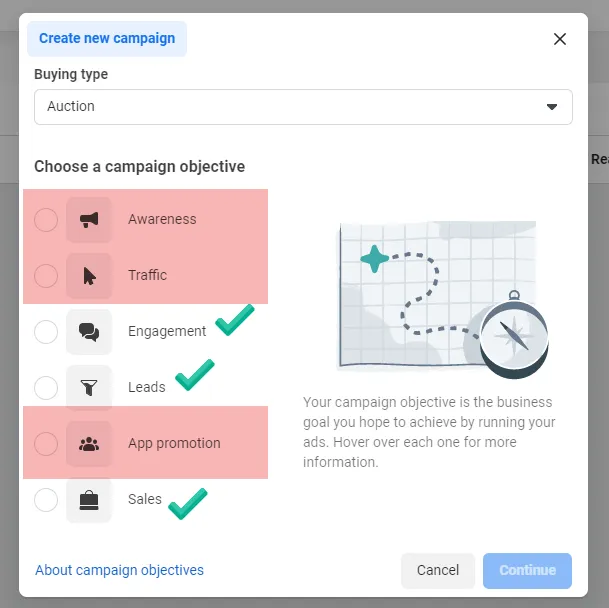
Section titled “Campaigns Not Found for Awareness and Traffic Objectives”Awareness and Traffic campaigns don’t optimize for a conversion event, so their ad sets carry no conversion pixel. Before July 2026, the Campaign Report and the Verify Your Ads tool did not display these campaigns at all.
Since the July 2026 update, AnyTrack also recognizes ads that use the connected pixel in the ad’s Tracking → Website events setting. Awareness and Traffic campaigns whose ads select the connected pixel there now appear in the Campaign Report with their spend, and conversions from those campaigns are attributed normally.
If an Awareness or Traffic campaign doesn’t appear, verify its ads select the connected pixel under Tracking → Website events. See Ads Ignored Under Other Pixels in Verify Ads for the steps.
Ads Ignored Under Other Pixels in Verify Ads
Section titled “Ads Ignored Under Other Pixels in Verify Ads”When you run Verify Ads Settings, the results may include a message such as “Ignoring 4 ads found under other pixels.” Meta reports those ads as associated with a different Pixel (dataset) than the one connected to your AnyTrack property. AnyTrack only manages ads associated with the connected pixel, so it skips them during verification, and their campaigns don’t appear in the Campaign Report.
This can look confusing because tracking still works: the AnyTrack Tag records visits from those ads, and events show the ad set and ad names under the content and term attributes when the UTM template is installed. The missing piece is the ad-to-pixel association on Meta’s side, not your tracking setup.
Meta associates an ad with a pixel in two places, and they can disagree. The ad set’s Conversion section sets the pixel Meta optimizes for, locked in when you create the ad set. The ad’s Tracking → Website events setting selects the pixel that records the ad’s traffic. AnyTrack recognizes an ad when either place matches the connected pixel, so Verify Ads ignores an ad only when the pixel is different in both. An ad set duplicated from an older campaign, or created with a different default dataset, commonly points to the wrong pixel this way.
Check which pixel the ads use, in both places:
- In Meta Ads Manager, open the Ads tab and click Edit on one of the ignored ads.
- Scroll to the Tracking section and note the Pixel (dataset) selected under Website events.
- Open the Ad sets tab and click Edit on the ad set of the same ad.
- Find the Conversion section and note the Pixel (dataset) selected for the conversion event.
- Compare both with the Pixel ID connected in AnyTrack under Tracking Pixels.
Fix the mismatch:
- The ad’s Website events dataset is different: switch it to the pixel connected in AnyTrack and publish. Meta accepts the change while the ad runs. One match is enough for AnyTrack to recognize the ad.
- The ad set optimizes for a different dataset, and you want Meta to optimize for the connected pixel: Meta locks the ad set’s pixel at creation on most objectives. If Ads Manager lets you edit the pixel in the ad set’s Conversion section, switch it and publish. If Ads Manager blocks the edit, duplicate the ad set with the connected pixel selected in its Conversion section, and publish the duplicate.
- You want to keep using the other pixel: connect it to AnyTrack as an additional Meta Pixel and install the UTM Tracking Template on its campaigns. You can connect multiple Meta Pixels to the same property, each configured individually.
- The ads are Advantage+ Catalog (dynamic product) ads: confirm the catalog is linked to the connected pixel. See Dynamic Catalog Campaigns Not Recognized as Active.
After the fix, run Verify Ads Settings again to verify the ads are no longer ignored. If the connected pixel already appears in the ad’s Tracking section or the ad set’s Conversion section and Verify Ads still ignores the ads, contact support with a screenshot of both screens and the Verify Ads results.
Dynamic Catalog Campaigns Not Recognized as Active
Section titled “Dynamic Catalog Campaigns Not Recognized as Active”A Facebook dynamic catalog campaign (Advantage+ Catalog Ads, also called Dynamic Product Ads) can appear in AnyTrack as Meta but never register as active: no impressions, link clicks, ROAS, or attribution results, even though AnyTrack detects the campaign ID and name and the correct pixel and ad account are connected.
This happens when the product Catalog is not linked to the connected Pixel in Meta. Dynamic ads serve from a catalog, and if that catalog isn’t associated with the same Pixel/Dataset you connected to AnyTrack, the campaign’s events aren’t tied to your pixel, so AnyTrack can’t recognize the campaign as active or attribute its conversions.
As with every campaign, the Campaign Report and Verify Ads only display campaigns that generate conversion events tied to the connected pixel.
Find Campaigns Using Campaign ID
Section titled “Find Campaigns Using Campaign ID”Use Campaign IDs to find and manage your campaigns with greater precision than campaign names.
In Facebook Ads Manager:
- Click Customize columns from the Columns dropdown menu
- Add the Campaign ID column
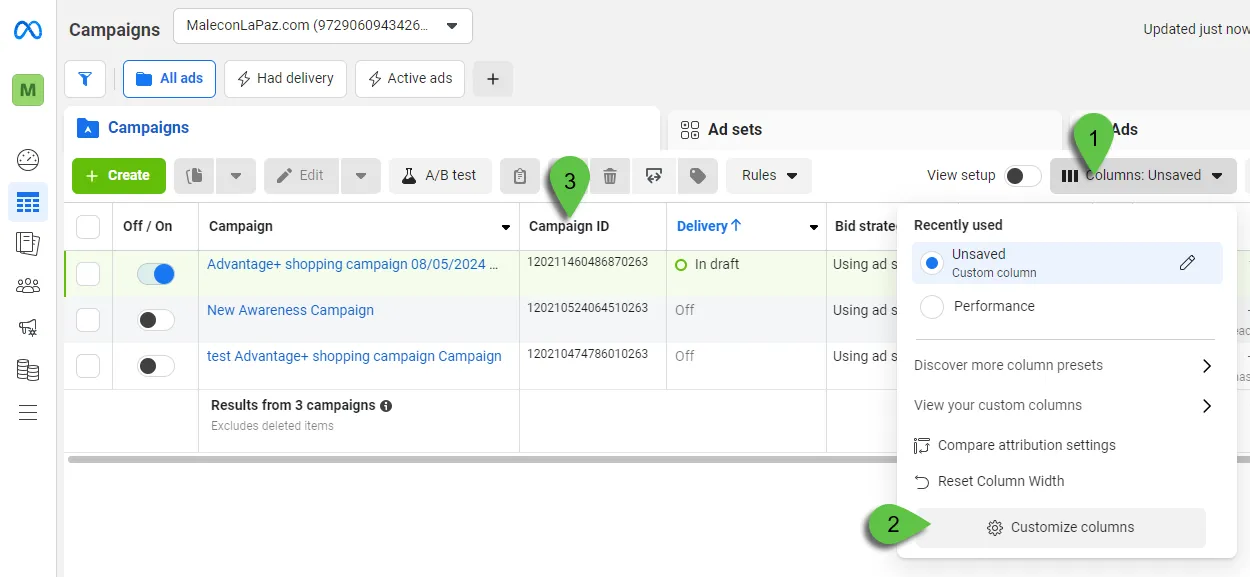
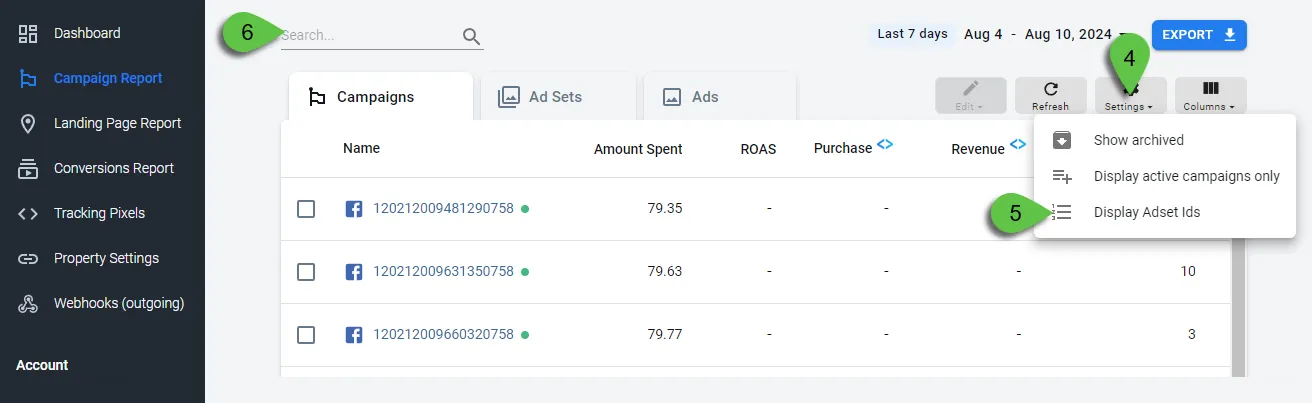
In AnyTrack Campaign Report:
- Click the Display Adset Names/Ids selector from the Settings menu
- Use the search box to find the Campaign ID
Playbook
-
 Shopify
 -
 Facebook Ads
Send Shopify Purchases to Meta Conversions API
The 20-minute fix for iOS signal loss. Full-funnel checkout events, sent server-side and deduplicated by AnyTrack before they reach Meta.
Related Troubleshooting Resources
Section titled “Related Troubleshooting Resources”Depending on your issue, these specialized guides may help:
- Event Match Quality Issues - Low EMQ scores, missing parameters, data quality
- UTM Tracking Template Problems - Red/yellow marks in verification, template errors
- Advanced Configuration Issues - Event mapping, Catch-All mode, custom audiences, UID parameters
- Business Manager Permissions - Access issues, missing permissions, asset configuration
- Install AnyTrack Tag - Get the AnyTrack Tag live on your site
- Ad Platforms Attribution - How attribution and reporting delays work
- Event Mapping - Map conversions to ad platform events
Frequently Asked Questions
FAQ was last reviewed on 2026-10-23
Why does my Facebook Ads account get disconnected?
Why do I not see test results in Meta Events Manager?
Meta shows an event I never configured, such as SubscribedButtonClick. Does AnyTrack send it?
SubscribedButtonClick (see the full steps).My events are in AnyTrack but Meta Events Manager shows nothing. What do I check?
A developer removed the AnyTrack Tracking Tag. Do I add the Meta Pixel to my theme instead?
Why don't I see all my campaigns in the AnyTrack campaign report?
What does 'Ignoring ads found under other pixels' mean in Verify Ads Settings?
Can I connect multiple Meta Pixels to the same property?
If I have several pixels in my Meta account, does AnyTrack automatically use all of them?
- In AnyTrack, navigate to Tracking Pixels. On the Facebook Pixel card, click Connect Pixel. If a Meta Pixel is already connected, click Add Pixel or Add New under it.
- Follow the prompts to authenticate your Facebook account and select the correct ad account and pixel.
- In the Facebook Conversion API section, turn on Enable server-to-server tracking and save changes.
- Install the UTM Tracking Template on the campaigns using that pixel, then run Verify Ads Settings for that Meta Pixel.
I don't see offline conversion events, why?
Can I use AnyTrack's UTM template with another software's parameters?
utm_source. Example: utm_source=facebook&utm_medium=cpc&tw_id={{ad.id}}.